
Release
Notes
New in 2.4.8
v Ubuntu 20/22 Linux Support
v Migration to PostgreSQL 12
v Introducing Loops
v Introducing FixIt
v New UI/UX (Coming Soon!)
v Water Tracing/Isolation (In Development)
v Notification Campaigns (In Design)
For notes on bug fixes and lesser enhancements, please visit
the Knowledge
Base.
Ubuntu 20/22
Linux Support
New for 2.4.8 is the ability to provision a Linux OMS using Ubuntu 20 or 22. This transition to Linux offers:
v Enhanced Security
v Boosted Performance
v Improved Stability/Reliability
v Simplified Administration
v Lower Cost of Ownership/Maintenance
Linux distributions allow us to better track security and performance updates across many of the platforms that the OMS relies on, including Apache HTTP Server, PostgreSQL and PostGIS, and PHP scripting tools.
It also helps us move toward a more automated means of administration and monitoring, which ultimately means better support for you, the customer.
Migration
to PostgreSQL 12
With the latest version, we have abandoned MySQL entirely and have wholly adopted PostgreSQL as our ORDBMS of choice, across all platforms. A few reasons for the transition:
v Object-oriented Programming
v Data Type Variety
v Improved Indexing
v Performance Scaling
v Synchronous Replication
v Open Source // Community Development
Introducing
Loops
The much-anticipated connectivity loop processing feature, aptly referred to simply as Loops, is here!
The Loops feature allows the user to close a switch that is currently energized on both sides. This allows switching in the field to be more accurately represented by the OMS, and in the correct sequence. The user will no longer need to open the circuit upline before closing the target element.
For isolation switching and load transfer operations, loops are expected to be temporary. To isolate or back-feed a circuit, you will still need to open a device or insert a cut; connectivity will only be re-evaluated once an opening is created along the path of the loop.
A circuits source does not change when a loop is created; nodes down-line of a loop will continue to associate their connectivity back to its original source.
Traces performed on a loop will continue to behave as normal.
Loops are considered to be confirmed energized - outage predictions will not be created along the loop path; existing outages along a loops path are unaffected by the loop.
Enabling loops will require
additional configuration for existing customers. Please contact Support for additional
information.
Seen below are traces of two (2) separate circuits which meet at an open tie switch.
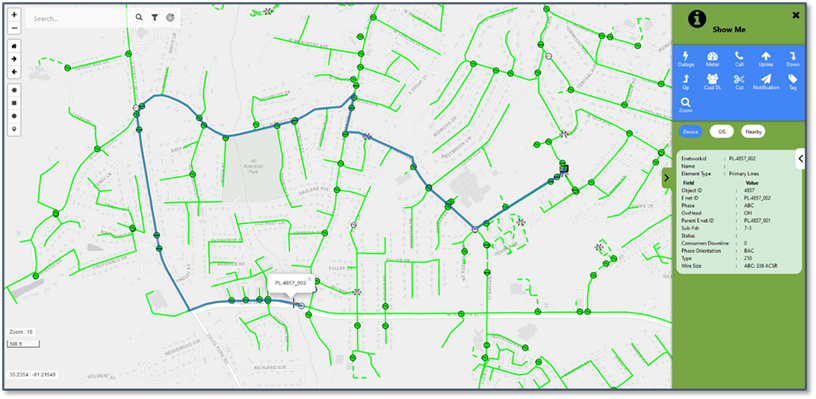
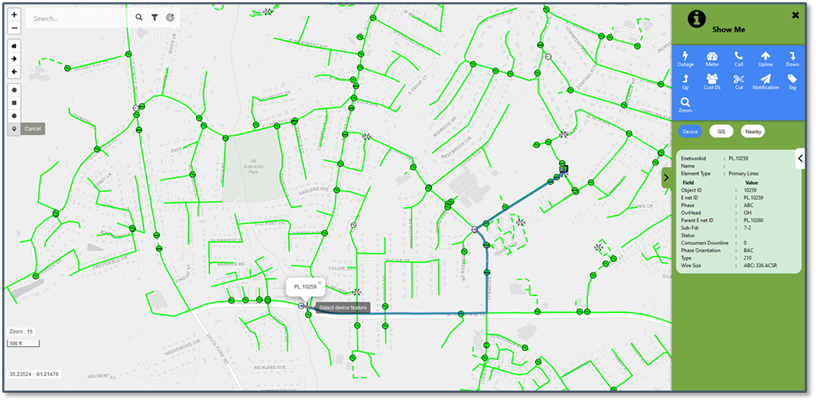
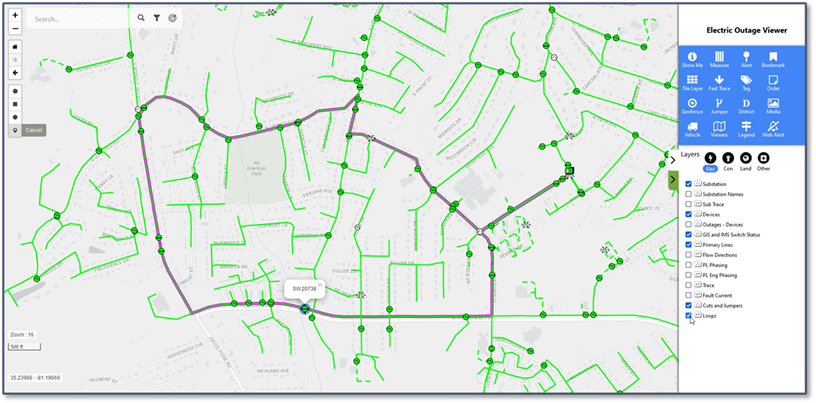
When the tie switch gets closed, a loop is created. Line segments included in the loop are represented by a magenta outline that extends in each direction back to the source or a common parent element. Loops are displayed as a toggleable map layer under the Elec tab.
Current Limitations
v
Loops will only work with up to two (2) unique
sources. Introducing a third source will generate an error.
v
Once a loop is created, no other loop(s) may be
created that would overlap the existing loop, in part or whole.
v
Just as we do not allow switches to be closed
that would cause a 2-phase line to feed into a 3-phase line, loops cannot be
created when a portion of the circuit (to be included in the loop) transitions
from 3-phase to 2-phase or vice versa.
Introducing
FixIt
For organizations looking to field and communicate the status of work items other than outages to and from their customer base while managing them within the OMS environment, DataVoice has a new solution. Introducing FixIt, a standalone extension to our existing web-based customer engagement suite that allows the public to report any issue within an organization’s service territory, regardless of asset type or account relationship.
Users first engage FixIt by selecting a point or asset on the map; the user is then prompted to select an issue type from a utility-defined list and provide any ancillary details and contact information. Each report results in a work order with a map location that can be managed from within the OMS and dispatched to WorkPal.
Map engagement is configurable for FixIt; users can click a location on the map to report their issue or associate it with a GIS-based asset.
FixIt reports can be restricted to a utility-provided polygon and can communicate a custom message to the user, when attempting to report an issue outside of this boundary.
New UI/UX
(Coming Soon!)
We’re very excited to announce a new UI/UX for the OMS, which we will be deploying with a forthcoming 2.4.8 release!
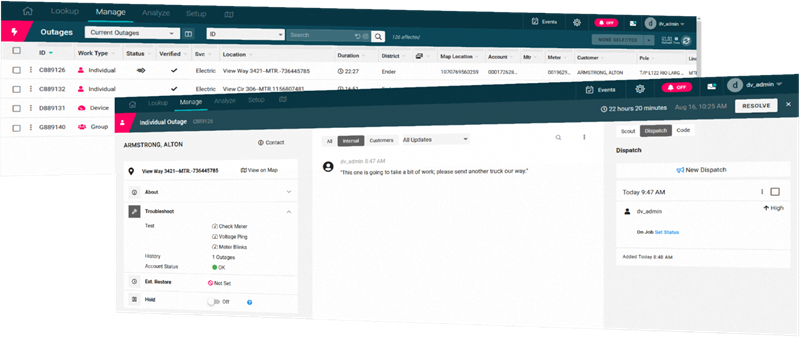
The new interface takes the design cues we have established with the previously revamped Find Customer & Outage Report pages and seamlessly applies them across the broader back-office experience.
The design direction focuses on what is important to the user and making those things as accessible and intuitive as possible. Here is a sneak peek!
Water
Tracing/Isolation (In Development)
Currently in development, more to follow!
Notification
Campaigns (In Design)
In the design phase, anticipated for a future 2.4.8 release.